


Every December, I see recruiting teams build hiring plans with real effort and good intent. And that matters, because a plan is not just a document. It is how you protect your team from chaos, align stakeholders, and make tradeoffs before the quarter starts.
If you are a new recruiting leader or you have just inherited a team, planning is one of the fastest ways to earn trust. Not by promising aggressive timelines, but by showing you can predict what is realistic, explain why, and adjust early when the inputs change. That skill is learnable, but most people were never taught it. You get handed a headcount target and a deadline, and you are expected to “make it happen” without a clear way to translate goals into weekly execution.
That is why I built these recruiting tools.
They are not meant to replace judgment. They are meant to teach it. They help you turn hiring targets into capacity, turn capacity into req load, turn req load into priorities, and turn priorities into a rhythm your team can run every week/month. They also make bottlenecks visible early, so you can fix the system instead of pushing recruiters harder.
Planning is not about being perfect. It is about being prepared. And for new recruiting leaders, having a simple set of tools can be the difference between managing recruiting and reacting to it.
2026 will reward teams that understand their limits early, not the ones that promise everything and fix it later.
Capacity Is Not A Feeling
Most recruiting problems start with a sentence that sounds harmless.
“We should be able to handle that.”
I have heard it in leadership meetings, standups, and hallway conversations for years. It usually shows up right after a new req is approved, or when a stakeholder pushes for “just one more role.” Nobody means harm. Everyone is optimistic. And almost nobody does the math.
Capacity is not about how hard your team works. It is about how much focused work actually fits into a week. When capacity is guessed instead of calculated, recruiters become the shock absorber for every planning mistake. They stretch, multitask, and quietly trade quality for speed until something breaks.
What makes this worse is that capacity is often discussed at a team level, not at a human level. Five recruiters does not mean five equal workloads. PTO, role complexity, sourcing intensity, and stakeholder maturity all matter. Ignoring those differences creates plans that look fair on paper and feel brutal in practice.
This is why I built a simple capacity planner. Not to predict the future, but to make limits visible. When you map planned hires against real recruiter availability, including PTO and realistic req load, the conversation changes fast. Suddenly “yes” and “no” are no longer opinions. They are outcomes.
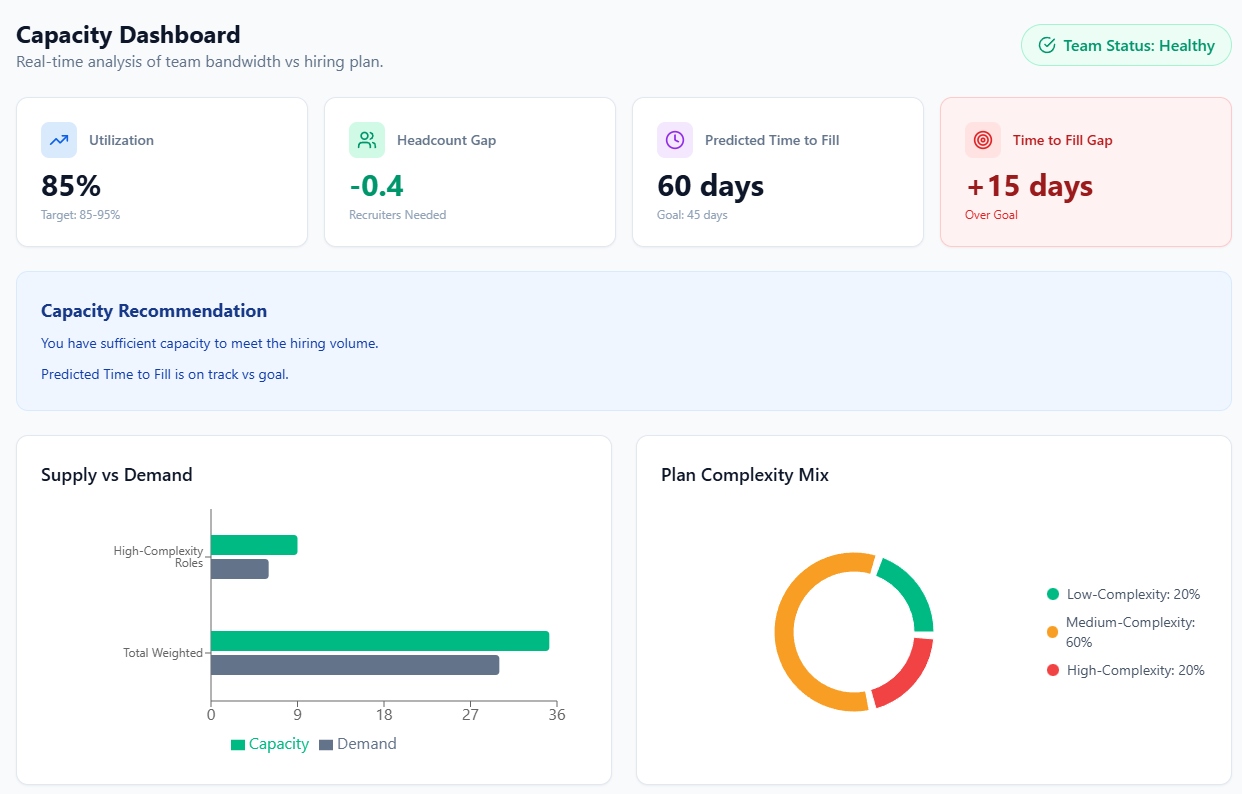
Once capacity is clear, everything else becomes easier. Prioritization stops being emotional. Sourcing expectations become realistic. And recruiters stop carrying the guilt of plans they never agreed to in the first place.
Capacity does not limit ambition. It protects it.
Reverse Funnel Math Ends Wishful Sourcing
Most hiring plans start at the finish line.
“We need 30 hires next quarter.”
“We need 120 hires next year.”
Those numbers look precise. They feel serious. But they hide the hardest part of recruiting, everything that must happen before an offer is signed.
This is where wishful thinking creeps in. Teams assume sourcing will somehow scale. That pipelines will magically refill. That recruiters will “figure it out” once the reqs open. Nobody explicitly says this, but the plan quietly depends on it.
The real problem is simple. Hiring targets are almost never translated into volume targets.
How many interviews are needed to get one hire? How many screens to get one interview? How many sourced candidates to get one screen? How many outreach messages to get one reply?
Without this math, sourcing is driven by pressure, not clarity.
Some teams panic halfway through a quarter because their pipeline suddenly feels thin. More sourcing is demanded. More messages are sent. More hours disappear. And yet nobody can answer a basic question. Are we actually behind, or does it just feel that way?
Reverse funnel math fixes this blind spot.
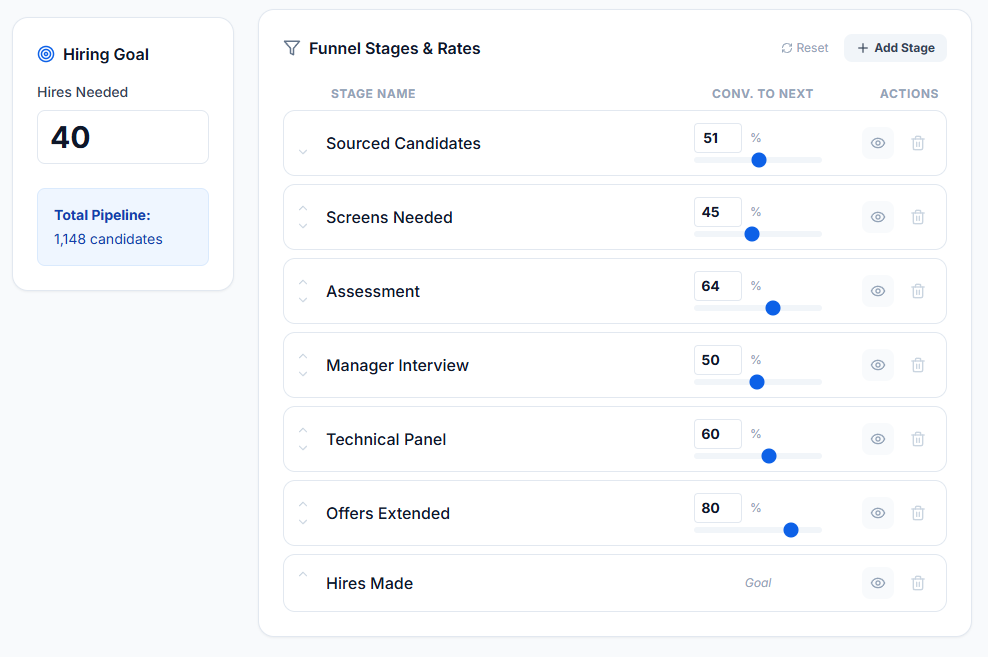
When you start with the hire and work backwards, the fog lifts quickly. If one hire usually takes four interviews, and each interview takes three screens, and each screen takes ten sourced profiles, the scale of the task becomes visible. Not scary, just honest.
This is exactly why I built a reverse funnel calculator. Not to be precise to the decimal, but to force alignment on assumptions. Conversion rates do not need to be perfect. They need to be agreed upon. Once they are, sourcing stops being reactive and starts being planned work.
That is also where outreach efficiency comes in. Knowing the total volume is only half the story. You also need to know how fast your team can realistically produce it. Daily outreach limits, response rates, and recruiter availability all shape what is possible in a given week.
When these numbers are visible, something important happens. Urgency becomes proportional. Leaders stop asking for miracles. Recruiters stop feeling behind when they are actually on track. And missed targets are discussed as system issues, not personal failures.
Reverse funnel math does not make hiring easy. It makes it fair.
Prioritization is A System, Not a Meeting
When everything is urgent, nothing really is.
Most recruiting leaders recognize this problem instantly. Ten open roles. Five loud stakeholders. Three real fires. And a constant stream of “just checking in” messages that slowly hijack the day. Prioritization turns into a negotiation, not a decision.
The common response is another meeting. Or a long Slack/Teams thread. Or a spreadsheet that looks impressive and gets ignored by Friday. The issue is not effort. The issue is that prioritization lives in people’s heads instead of a shared system.
Without a system, urgency wins. The most senior voice, the loudest escalation, or the most recent message gets attention. Recruiters learn this fast. They adapt by context switching constantly, which feels productive but quietly destroys throughput and focus.
This is where most teams get it wrong. They treat prioritization as a one-time alignment exercise instead of an ongoing operating rule. But priorities change as capacity changes. And capacity changes every week.
That is why I built a req prioritization tool that forces tradeoffs into the open. Not a ranking for ranking’s sake, but a simple way to score roles based on agreed criteria. Business impact. Revenue tie. Hiring risk. Time sensitivity. Role difficulty.
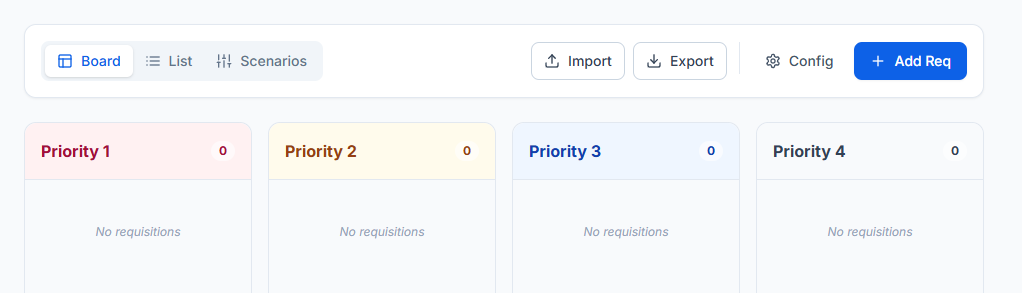
Once those inputs are visible, prioritization stops being personal. You can see which roles truly deserve attention first, and which ones move down when capacity tightens. More importantly, you can show stakeholders the consequences of their requests.
If you add this role, this one slows down.
If you want this filled sooner, that one waits longer.
This is an uncomfortable conversation, but it is a healthy one. It replaces silent overload with explicit choices. It also protects recruiters from being pulled in five directions at once while being measured on speed and quality.
A system does not remove judgment. It supports it. It gives you a consistent way to decide, revisit, and explain priorities as conditions change.
When prioritization becomes a visible system, not a recurring debate, recruiting stops reacting and starts steering.
Outreach Efficiency Turns Sourcing From Pressure Into Planning
Every time pipeline runs thin, the same conversation appears.
“We need more sourcing.”
It sounds reasonable. It feels actionable. And it is almost always incomplete.
What teams really mean is that they need more candidate responses. But responses are the outcome, not the input. The input is outreach volume, and outreach volume lives inside very real time constraints that are rarely acknowledged.
Recruiters do not just source. They screen. They interview. They prep candidates. They chase feedback. Outreach competes with all of it. When leaders push for more sourcing without understanding outreach capacity, they are not increasing effort. They are redistributing attention.
This is where most hiring plans quietly break.
Reverse funnel math tells you how many candidates you need at the top to hit your hiring goal. But it does not tell you how fast that top of funnel can be produced. That speed depends on how many messages a recruiter can realistically send, personalize, follow up on, and manage without quality collapsing.
I built an outreach efficiency tracker because this gap kept showing up in real planning conversations.
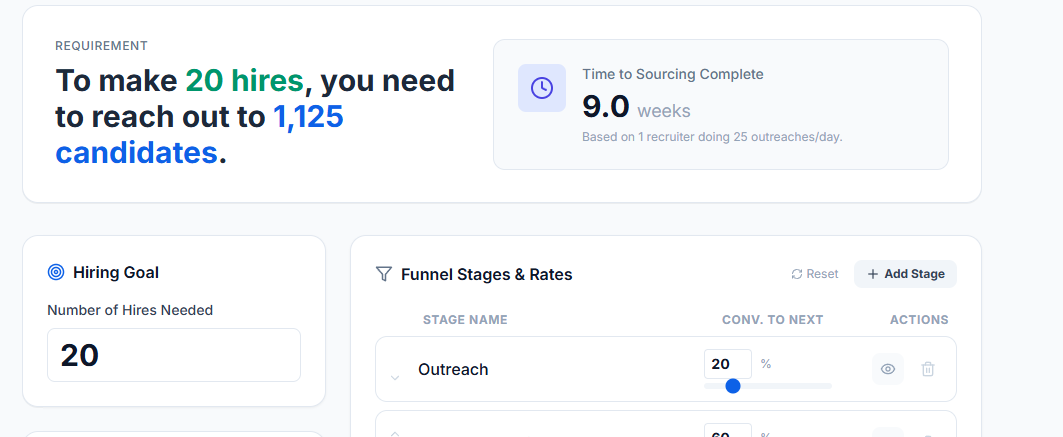
When you connect daily outreach limits with response rates and recruiter availability, the story changes fast. Suddenly, “we need to double pipeline” turns into a concrete requirement. More messages per day. More time spent sourcing. Or more people doing the work.
Sometimes the numbers show the ask is reasonable. Often they show it is not.
This is not about limiting ambition. It is about removing false urgency. When outreach expectations are explicit, teams stop mistaking capacity limits for performance issues. Recruiters stop feeling behind for failing to do the impossible. Leaders stop escalating problems that were baked into the plan from day one.
Outreach efficiency sits at the intersection of planning and execution. Without it, sourcing feels chaotic. With it, sourcing becomes predictable, even when demand is high.
Reverse funnel math tells you how much volume you need. Outreach efficiency tells you whether your team can actually produce it.
That difference is where realistic hiring plans are made.
Articles you should read:


Bottlenecks Hide In Plain Sight
When hiring slows down, recruiters usually take the blame.
Pipeline feels stuck. Offers drag. Candidates drop out. The assumption is almost automatic. Sourcing is weak. Follow ups are slow. Recruiters need to push harder.
Most of the time, that assumption is wrong.
The biggest delays in hiring rarely sit with recruiters. They sit in places that feel small in isolation and devastating in combination. Interview scheduling takes a week instead of a day. Feedback that arrives late or not at all. Hiring managers who review profiles in batches, once a week, if you are lucky. Offer approvals that bounce between finance and leadership while candidates wait.
These delays are easy to miss because nobody owns them end-to-end. Each step feels reasonable on its own. Together, they quietly stretch your time to hire until speed becomes impossible.
This is why I pay so much attention to pipeline aging.
If you only look at totals, average time to hire, and average time in stage, you miss the story. Averages hide pain. What matters is where candidates sit idle and for how long. Not days in process overall, but days doing nothing.
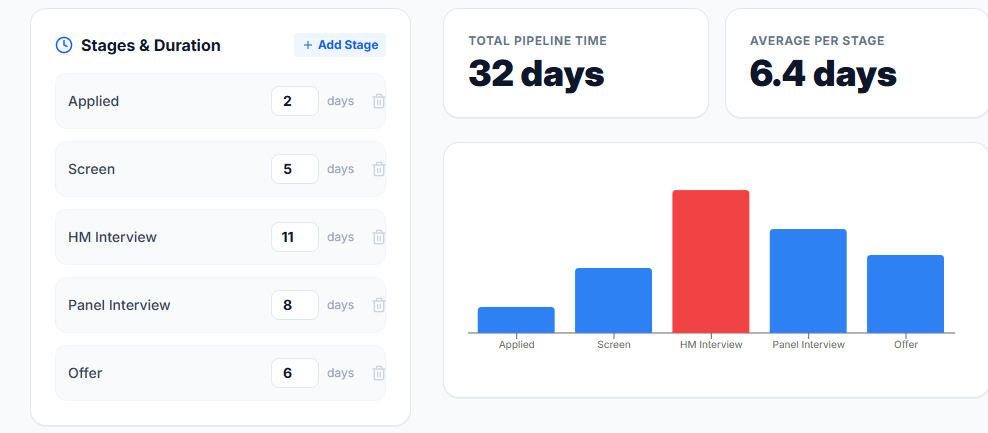
When you map how long candidates spend in each stage, patterns show up fast. Screens that wait three days for feedback. Final interviews that stall because calendars never align. Offers that sit unsigned because approvals are unclear. None of these issues can be fixed by sourcing harder.
I built a simple hiring process timeline tool for this exact reason. It does not judge performance. It exposes reality. When every stage has an expected duration and an actual duration, delays stop being invisible. They become discussable.
This changes the conversation in leadership meetings. Instead of “recruiting is slow,” you can say “interviews add nine days we did not plan for,” or “offer approvals double our close time.” These are solvable problems, but only once they are named.
Candidate pipeline aging does something else that matters. It protects your employer brand. Candidates rarely leave because the role is wrong. They leave because silence feels like disinterest. Every idle day increases drop off risk, even for strong offers.
Speed is not about rushing. It is about removing unnecessary waiting. When you fix bottlenecks, recruiters do not need to work harder. The system works cleaner.
Hiring does not fail loudly. It fails quietly, one delay at a time.

Learn how to harness AI effectively and get better results every time. You can grab the book on Amazon (Paperback, Hardcover, Kindle) —no matter where you are!
Build A Recruiting Operating System, Not a Tool Graveyard
Most recruiting teams do not fail because they lack tools. They fail because tools are added one by one, in response to pain, without ever changing how decisions are made. A new dashboard appears. A new report gets shared. A new spreadsheet lives for a month, then quietly dies.
The result is familiar. Plenty of data. Very little clarity.
The real shift happens when tools are treated as part of an operating system, not a collection of fixes. An operating system defines how decisions get made, how often they are revisited, and who owns the inputs. Without that rhythm, even the best tools become noise.
I always start with one simple question. Which decision keeps coming back every week?
Is it “can we take on more roles”?
Is it “why is this role still open”?
Is it “where did the budget go”?
Pick one. Then attach a tool to that decision and make it unavoidable.
A capacity view belongs in weekly planning. Not quarterly. Not as a backup slide. Every week. A prioritization view belongs in stakeholder conversations, so tradeoffs are visible, not implied. Pipeline aging belongs in reviews, so delays are discussed while they are still fixable.
This does not require a massive rollout. It requires discipline.
One planning tool.
One execution tool.
One financial guardrail.
Used consistently, these three change behavior. Recruiters stop apologizing for constraints. Leaders stop being surprised. Hiring managers start seeing recruiting as a system, not a service desk.
The biggest mistake I see is teams trying to do everything at once. That creates resistance and fatigue. The better move is to remove one recurring argument from your week. Just one. When that argument disappears, the value becomes obvious.
Recruiting maturity is not about sophistication. It is about repeatability.
If your 2026 plan only works when everything goes right, it is not a plan. A real plan survives reality.
Before You Add More Tools, Fix How Decisions Are Made
If you read everything above and thought, “This all makes sense, but my team would still struggle to make it stick,” that reaction is completely normal.
Most recruiting teams do not fail at planning. They fail at execution rhythm.
You can calculate capacity, map funnels, prioritize reqs, and expose bottlenecks. And yet, a month later, the same arguments resurface. Not because the tools were wrong, but because nothing changed in how decisions were revisited, reinforced, and governed week after week.
This is the gap almost nobody talks about.
Recruiting tools explain reality. An operating cadence turns that reality into behavior. Without cadence, tools become reference material. With cadence, they become guardrails.
That is why the bonus section goes beyond calculators and frameworks. It focuses on how to run recruiting like a system, with shared definitions, light governance, and a weekly rhythm that prevents chaos before it starts.
If your goal for 2026 is fewer fire drills, fewer escalations, and fewer “how did we get here” moments, this is the part that makes everything else work.