


On January 8, 2026, Google launched Gmail’s AI Inbox. Three billion users now have an AI assistant that reads every email and decides what deserves attention.
Most recruiters missed what this actually means.
Gmail’s AI analyzes sender intent, relationship context, and engagement patterns. If it predicts the recipient won’t find your message valuable, your email gets filtered into obscurity. Not spam. Just buried where candidates will never see it.
Here’s the part that should scare you: every ignored email trains the AI to hide your next one. Volume isn’t helping you anymore. It’s killing you.
Most recruiters are responding by buying better AI email writers and testing new subject lines. They’re solving the wrong problem. Your emails now face seven filtering layers before reaching humans. Better copy won’t save you when the game itself changed.
You have about 90 days to rebuild your outreach infrastructure. After that, you’ll be competing against recruiters who already pivoted while you were still optimizing templates.
Your candidates didn’t disappear. They’re just not in the inbox folder where your emails are getting buried.
Volume-Based Outreach Is Mathematically Dead
Let me show you why the math no longer works for high-volume email in 2026.
Take a typical recruiting (agency) setup from 2024. You’re sending 150-200 emails daily from a warmed-up domain. Industry benchmarks showed cold email reply rates averaging 2-4% for recruiting outreach. That meant 3-8 replies per day, with maybe 1-2 turning into actual conversations. Not great, but the volume made it work.
Here’s what email deliverability platforms are tracking in 2026.
Gmail’s engagement-based filtering now analyzes whether recipients respond to, delete, or ignore your emails. According to deliverability monitoring services, senders with consistently low engagement rates see their inbox placement decline progressively. When most recipients ignore your emails, Gmail interprets this as a signal that your messages aren’t valuable.
The cascade effect works like this: each ignored email contributes to your sender reputation score. As that score declines, future emails get filtered more aggressively. Email marketing research shows this creates a death spiral where low engagement leads to worse placement, which leads to even lower engagement.
Industry data from cold email platforms suggests that recruiting emails face particular challenges because they inherently generate lower engagement than transactional or relationship-based email. A recruiter reaching out to passive candidates who didn’t ask to be contacted will naturally see lower response rates than, say, a SaaS company emailing active trial users.
Let’s look at what this costs you. A standard email outreach infrastructure includes an outreach platform ($100-200/month), secondary domains for cold outreach ($50-80/year each), email warmup services ($50-100/month), and contact enrichment tools ($150-300/month). You’re looking at $400-600 monthly before factoring in your time.
Compare this to the alternative channels. LinkedIn InMail, according to LinkedIn’s own recruiting statistics, achieves response rates of 18-25% versus cold email’s 2-3% in 2026. That’s roughly 6-8 times better performance. Phone outreach, when you reach the right person, converts conversations at even higher rates according to sales development research.
Here’s a realistic scenario based on recruiter experiences shared in industry forums. An agency sending high email volumes in December 2025 might have been making 12-15 placements monthly. By February 2026, maintaining the same email volume with the same targeting, they’re seeing significantly fewer responses. Some agencies report their email-sourced placements dropping by 40-60% in the first quarter of 2026.
The fundamental problem is this: you can’t scale your way out of an engagement problem. Sending more emails while getting low response rates doesn’t build your pipeline. It builds resistance in the filtering systems designed to protect inboxes.
You should treat cold email like a precision instrument, not a volume play. The recommendation from platforms like Mailshake and Instantly is keeping daily sends under 40-50 per account for new domains, with extensive warmup periods.
That’s not a tweak to your existing strategy. That’s a completely different model.
The question isn’t whether email still works at all. It’s whether your current approach matches the new reality. And for most recruiters still running 2024’s playbook, the answer is no.
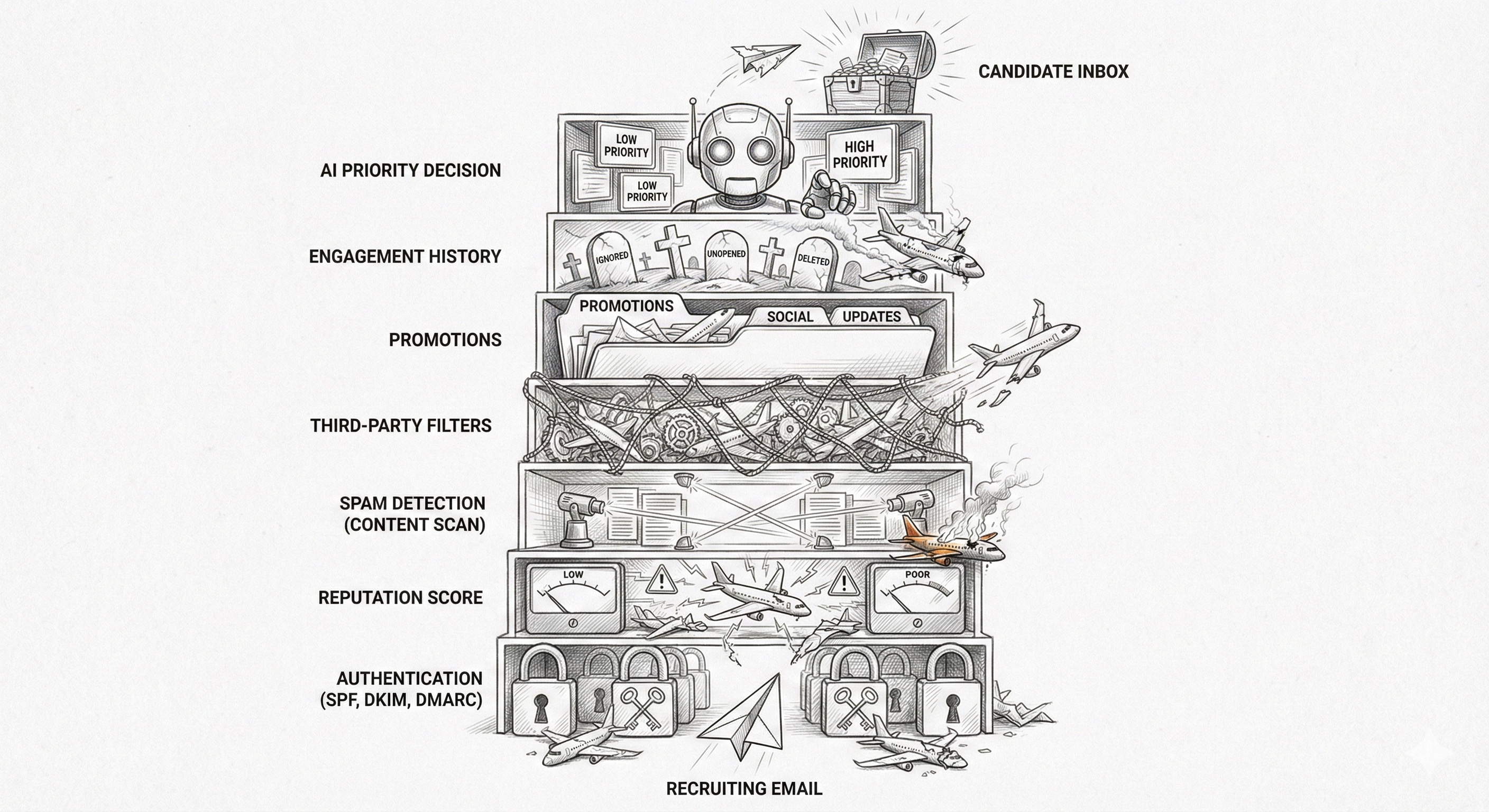
Every Email Runs a Gauntlet Before Humans See It
Your recruiting email doesn’t just need to be well-written. It needs to survive seven distinct checkpoints before a candidate even has the chance to ignore it.
Let me walk you through what actually happens between “send” and “inbox.”
Filter 1: Authentication and Infrastructure
Before Gmail even looks at your email content, it checks whether your sending infrastructure is legitimate. This means verifying SPF (Sender Policy Framework), DKIM (DomainKeys Identified Mail), and DMARC (Domain-based Message Authentication, Reporting, and Conformance) records.
As of November 2025, Gmail began strictly enforcing these requirements for bulk senders. If your authentication fails, your email gets rejected at the SMTP level before it even enters the inbox. According to Gmail Postmaster Tools documentation, this happens before any other filtering.
Most recruiting outreach tools handle this automatically, but here’s the catch: if you’re sending from multiple domains or using secondary domains for cold outreach, each one needs proper authentication setup. Miss one configuration, and those emails bounce.
Filter 2: IP and Domain Reputation
Gmail tracks the sending history of your domain and IP address. Send too many emails from a single account too quickly, and you trigger volume-based filtering. Use the same IP address across too many accounts, and the system flags the pattern as suspicious.
Email deliverability research shows this reputation system is cumulative. A new domain starts with neutral reputation and builds (or destroys) it based on recipient behavior. High bounce rates, spam complaints, or low engagement all damage your score. Once damaged, rebuilding reputation takes weeks of careful sending.
This is why email experts recommend the 40-50 daily limit for new domains and 14-21 day warmup periods. You’re not warming up the technology. You’re establishing a positive reputation pattern.
Filter 3: Content Pattern Recognition
Gmail’s spam filters analyze your email content for patterns that match known spam or mass marketing. This includes looking at subject line structure, salutation style, link patterns, HTML formatting, and footer elements.
According to email deliverability platforms like Allegrow, the filters are trained on billions of emails. They recognize templated language, even when you’re using personalization tokens. Phrases like “just wanted to reach out” or “I hope this email finds you well” have been flagged so many times that they carry negative weight.
The system isn’t looking for specific banned phrases. It’s looking for the statistical signature of mass outreach.
Filter 4: Third-Party Spam Filtering
Many companies use additional spam filtering layers beyond Gmail’s default protection. Tools like MixMax, SpamTitan, and Barracuda add their own detection algorithms on top of Gmail’s filtering.
These services often flag cold outreach more aggressively than Gmail’s native filters because they’re designed to protect corporate inboxes from sales and recruiting spam specifically. Your email might pass Gmail’s filters but get caught by a company’s additional protection layer.
You have no visibility into which candidates use these services. You just see the email delivered but never opened.
Filter 5: The Promotional Tab
If your email makes it through spam filtering, Gmail then decides whether it belongs in Primary or Promotions. According to Gmail’s categorization logic, emails with unsubscribe links, marketing-style footers, or promotional language get sorted to Promotions automatically.
Here’s the problem: compliance laws often require unsubscribe links in bulk email. But including them triggers promotional categorization. Don’t include them, and you risk spam complaints that damage your sender reputation.
Research on inbox placement shows that emails in the Promotions tab get opened at roughly one-third the rate of Primary tab emails. For many users, the Promotions tab is essentially a holding area they check once a week, if ever.
Filter 6: Engagement History
Gmail tracks how recipients interact with emails from your domain. If someone consistently deletes your emails without opening them, or opens them but never responds, the system learns that this person doesn’t find your emails valuable.
According to email deliverability experts, this engagement data feeds into future filtering decisions. Your tenth email to someone who ignored the first nine will likely get filtered more aggressively than your first email to them.
This creates a compounding problem for recruiters. Candidates who aren’t looking for jobs ignore your emails. Their lack of engagement trains Gmail to hide your future emails, even if they might be interested later.
Filter 7: The AI Inbox Priority System
This is the newest layer, rolled out in January 2026. Gmail’s AI Inbox analyzes each email to predict whether the recipient will find it important. According to Google’s announcement, it evaluates sender relationships, message content, and timing to surface only “high-stakes” items to the primary view.
For recruiting emails, this is brutal. The AI can detect that you have no prior relationship with the recipient. It can be seen that the message is an outbound solicitation rather than an expected communication. It can compare your email to thousands of similar recruiting emails the recipient has received and ignored.
The AI doesn’t need to understand what you’re saying. It just needs to recognize the pattern of “unsolicited recruiting outreach to passive candidate” and assign it low priority.
According to Gmail’s product documentation, the AI Inbox prioritizes messages like bill reminders, appointment confirmations, and correspondence from frequent contacts. Cold recruiting emails don’t fit any of those categories.
The Cumulative Effect
Here’s what makes this gauntlet so deadly: you need to pass all seven filters. Passing six out of seven still means your email doesn’t reach the candidate in a way that prompts action.
Each filter operates independently with its own logic. There’s no single fix that solves all seven. And because Gmail doesn’t tell you which specific filter caught your email, you’re troubleshooting blind.
This is why “better email copy” doesn’t solve the problem. Your copy isn’t the issue when the email never reaches the folder where candidates look for important messages.
The filtering infrastructure isn’t designed to be fair to recruiters. It’s designed to protect users from the exact thing you’re trying to do: reach people who didn’t ask to hear from you.
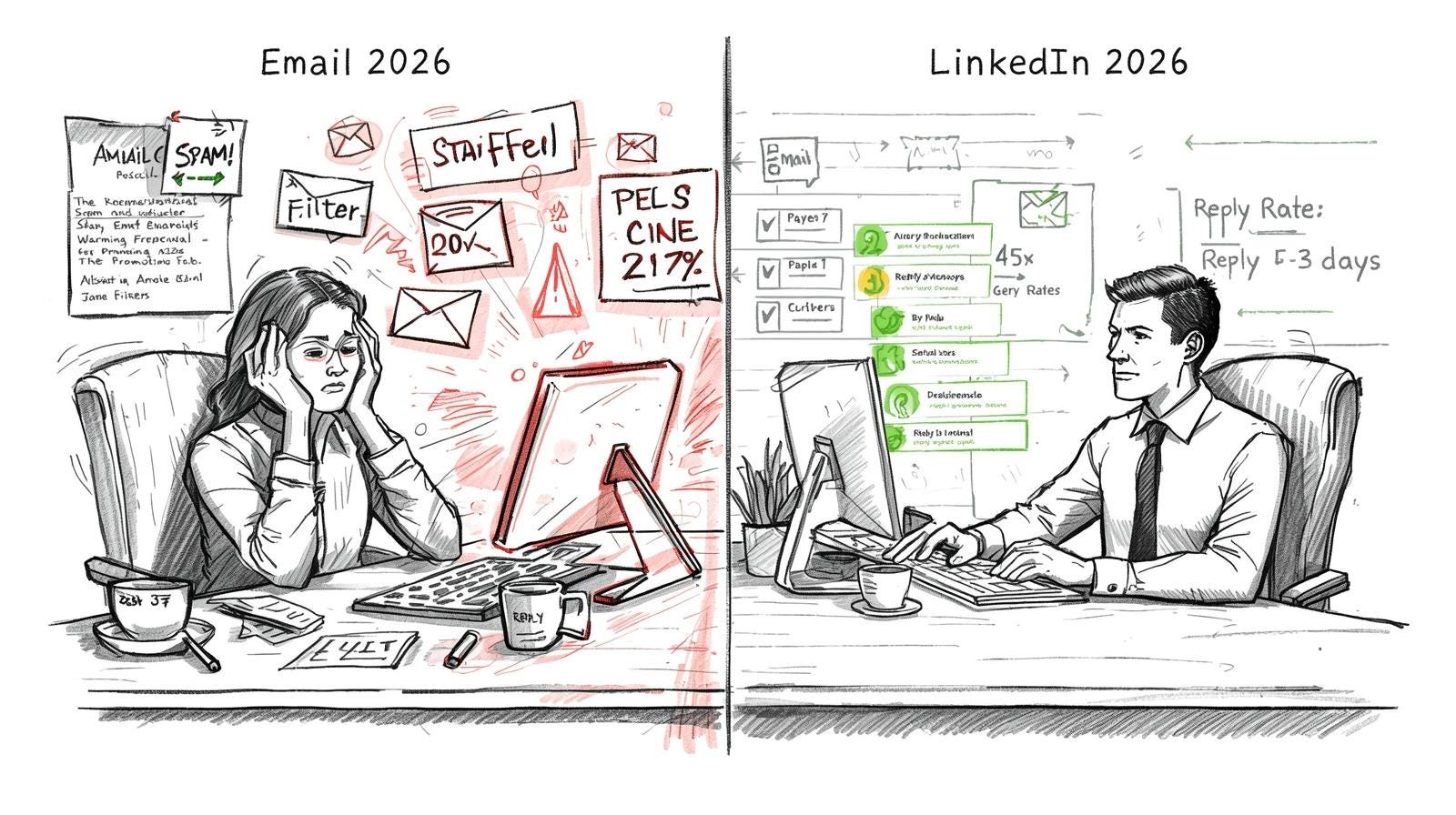
Where Response Rates Are 6X Higher
While you’re troubleshooting email deliverability, your competitors are booking meetings on LinkedIn at response rates that would seem impossible via email.
Let me show you why LinkedIn is now the primary channel for recruiter outreach in 2026.
The Response Rate Reality
According to LinkedIn’s official recruiting statistics, InMail messages achieve response rates of 18-25%. Compare that to cold email’s 2-3% in 2026, and you’re looking at roughly 6-8 times better performance.
This isn’t a marginal improvement. It’s a completely different game.
Industry data from LinkedIn outreach campaigns shows that well-executed strategies combining connection requests with personalized messaging can push reply rates to 30-35%. Some recruiters report even higher rates when targeting specific niches where they’ve built profile credibility.
Why the massive difference? Because LinkedIn solves all seven filtering problems that kill email.
Your Profile Is Your Credibility
Here’s what happens when a candidate receives your LinkedIn message. Before they even read it, they click your profile. In three seconds, they see your headline, your current role, how many connections you have, whether you have mutual connections, and your recent activity.
That profile view provides instant context that email can never match. They can verify you’re a real recruiter at a real company before investing time in your message. They can see you’ve placed people in their industry. They can check if you know people they know.
According to LinkedIn recruiting research, candidates who view your profile before responding are 27% more likely to engage when they see shared connections or relevant industry focus.
This is why profile optimization matters so much in 2026. Your profile isn’t just your resume. It’s the credibility layer that precedes every message you send.
The Pre-Engagement Advantage
LinkedIn lets you build familiarity before asking for anything. You can view someone’s profile (they get notified). You can engage with their content. You can send a connection request with a note. All of this happens before you send a message asking for their time.
This multi-touch approach creates recognition. When you finally send an InMail or message, you’re not a complete stranger. You’re the recruiter who viewed their profile last week and commented on their post about industry trends.
Industry benchmarks show that LinkedIn campaigns combining profile visits with connection requests before messaging achieve 11.87% reply rates, nearly double the rate of message-only approaches. The familiarity matters.
Email can’t replicate this. You can’t warm someone up before sending the first email. Your cold email is, by definition, the first touchpoint. LinkedIn lets you earn attention before asking for it.
The Scalability Constraint
Here’s where LinkedIn gets complicated. Even on premium Recruiter tiers, you’re capped to specific InMails per month. For recruiters used to sending 200 emails daily, this feels impossibly restrictive. You can’t scale LinkedIn the way you could scale email in 2024.
But that constraint forces better targeting. When you can only send 50 InMails monthly, you research harder. You prioritize better. You personalize more. The limitation becomes an advantage because it prevents the spray-and-pray approach that kills email deliverability. Unless, of course, you have Recruiter licences with more InMails.
According to recruiting statistics from 2026, 95% of recruiters use LinkedIn for candidate sourcing. That’s nearly universal adoption. But the ones getting results are treating those limited InMails like precision strikes, not scatter shots.
What Profile Optimization Actually Means
Your LinkedIn profile needs to answer one question for passive candidates: “Why should I talk to this recruiter?”
According to LinkedIn best practices for recruiters, profiles that clearly communicate industry specialization get higher connection acceptance rates. A headline like “Tech Recruiter” is generic. “Placing Senior Backend Engineers at Series A-C Startups” tells candidates exactly whether you’re relevant to them.
Your recent activity matters too. Candidates check if you’re active on the platform. If your last post was six months ago, you look like someone who only shows up when they need something. If you’re regularly sharing industry insights or job market data, you look like someone plugged into their field.
The Honest Limitations
LinkedIn isn’t perfect. The InMail cap is real and restrictive. LinkedIn Recruiter pricing is rising each year, making it expensive for solo recruiters.
And because 95% of recruiters use LinkedIn, candidates are drowning in recruiter outreach there too. You’re not escaping competition by moving to LinkedIn. You’re just competing in an environment with better baseline response rates.
But here’s what matters: when you compare the actual results, LinkedIn consistently outperforms email in 2026. Higher response rates, faster replies, better conversion from conversation to interview, and no technical deliverability nightmare to manage.
For most recruiters filling professional roles, LinkedIn should be your primary outreach channel, with email as a supporting tactic for specific situations.
Your candidates are on LinkedIn, actively using it for professional purposes, with their notifications turned on. That’s where you should be too.
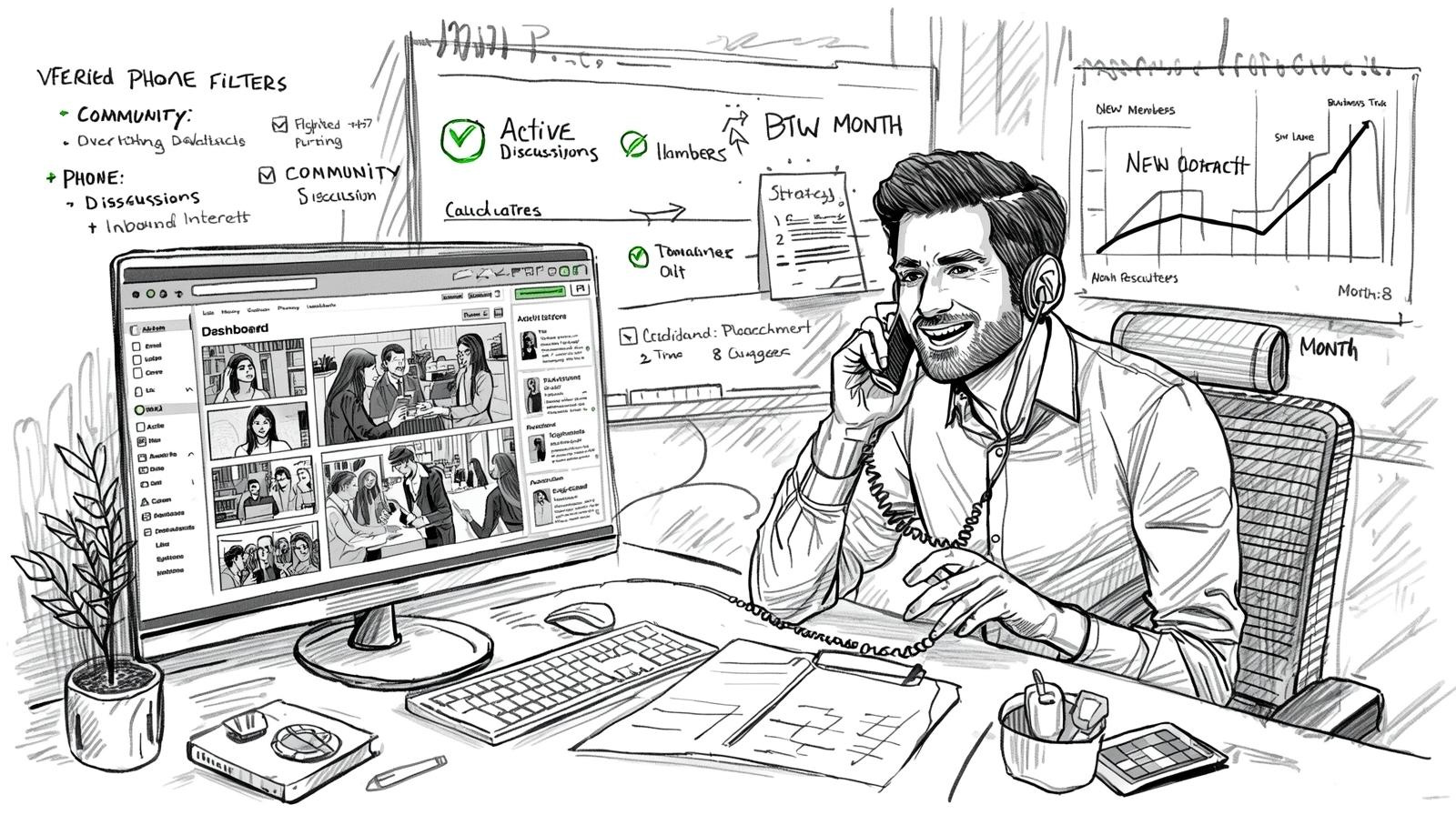
Building Moats While Competitors Fight Spam Filters
While most recruiters are arguing about which AI email tool writes better subject lines, the smartest ones quietly moved to channels that don’t require fighting algorithms at all.
Let me show you the two strategies your competitors are probably ignoring because they seem too old-school or too slow.
The Phone Database Advantage
Here’s the simplest filtering bypass imaginable: call them.
A verified phone number, especially a direct cell, eliminates every single digital filter we discussed in previus chapter. No authentication checks. No engagement algorithms. No AI Inbox. You either reach them or you don’t.
Many contact database providers offer access to millions of verified phone numbers. The challenge is accuracy. Phone number accuracy rates typically range from 60-80% for cell phones. But here’s what makes this valuable in 2026: most recruiters won’t do it.
Cold calling intimidates recruiters. It feels harder than sending emails. You can’t automate it the same way. All of that friction makes recruiters avoid the phone, which creates massive opportunity for the ones who embrace it.
Phone conversations convert at 3-5x the rate of email or InMail when you successfully reach decision-makers. Out of 50 calls, maybe you reach 15 people and convert 4-5 into scheduled follow-ups. That’s 8-10% on actual conversations.
Building Communities Instead of Chasing Candidates
Here’s the completely different approach: build the community where your target candidates already spend time.
A tech recruiter started a Discord server for React developers in 2024. He didn’t recruit from it initially. He just created a space for React devs to discuss technical problems and share resources.
The time investment was significant: 3-5 hours weekly for the first six months. But now it’s a self-sustaining talent pipeline that generates inbound interest.
This approach works across different formats. Slack groups for specific technical communities. Local meetups for geographic markets. Email newsletters sharing market intelligence. According to recruitment strategy research from 2026, relationship-driven approaches are becoming increasingly valued as transactional outreach becomes less effective.
The communities that work best have clear value beyond recruiting. A Slack group that’s just job postings dies quickly. A Slack group where people get genuine help with technical problems sustains itself.
Why This Creates Competitive Moats
Email infrastructure can be copied. Someone can use the same outreach tool, buy the same contact database, write similar templates.
A community you spent 12 months building can’t be copied. Your relationships with 500 data engineers represent real social capital that competitors can’t duplicate by buying software.
This is the ultimate long game. You’re building brand and relationships that compound over time instead of transactional outreach that resets to zero each week.
Your 90-Day Window Is Already Closing
Gmail’s AI filtering will get more sophisticated, not less. Other email providers will follow Google’s lead. The engagement-based algorithms will get better at detecting recruiting outreach. This trend moves in one direction.
You have two choices. You can spend the next six months optimizing tactics that are fundamentally broken, tweaking subject lines and testing new AI writing tools while your reply rates continue dropping. Or you can accept that the game changed and rebuild your outreach infrastructure around channels where the math still works.
The recruiters making this transition now have a 90-day advantage over the ones who wait. By April, they’ll have warmed-up LinkedIn profiles with established credibility. They’ll have phone databases verified and tested. They’ll have started the community-building process that pays off in Q3 and Q4. They’ll have realistic expectations about email’s role in their strategy instead of false hope that better tools will fix structural problems.
The ones who wait will make the same transition eventually. They’ll just do it in a panic when their pipeline finally runs dry and they have no choice. They’ll be learning LinkedIn outreach while trying to hit quarterly targets. They’ll be cold-calling for the first time under deadline pressure. They’ll be starting communities when they needed them six months ago.
The technology changed. Your candidates’ behavior changed. The only question left is whether your strategy will change before you’re forced to change it. Stop optimizing for a game that’s already over. Start playing the game that’s actually winnable.
You have 90 days to rebuild before your competitors who moved faster have filled the roles you’re still sourcing for.
The clock started in January.
Surgical Outreach Still Penetrates Filters
Email isn’t dead. Volume-based email is dead. There’s a difference.
If you’re willing to send 50 emails per week instead of 500, and spend 15 minutes on each one instead of 2 minutes, you can still get results. But the math only works for specific situations.
Let me show you what precision email actually looks like.