


The junior role died in about ninety seconds.
A friend who runs an engineering group at a mid-size software company in the UK told me this over dinner in April. The restaurant had run out of half the menu and we’d spent the first twenty minutes on his ongoing feud with a neighbour about a hedge, so the story arrived sideways, the way the useful ones usually do.
January planning call, half the participants on a train. Line by line through open headcount. A junior role he’d argued for two quarters earlier came up, and he said the tooling had changed enough that one experienced person could cover the work now, so could they make it a mid-level req instead. Everyone nodded, and they moved on.
Nobody in that call said the word “AI.” What got said was scope, seniority and a salary band.
I’ve thought about it a lot since reading the August update to Stanford’s payroll study, because the numbers suggest a version of that ninety seconds happened almost everywhere at once, and that most of the people it happened to will never know it did.
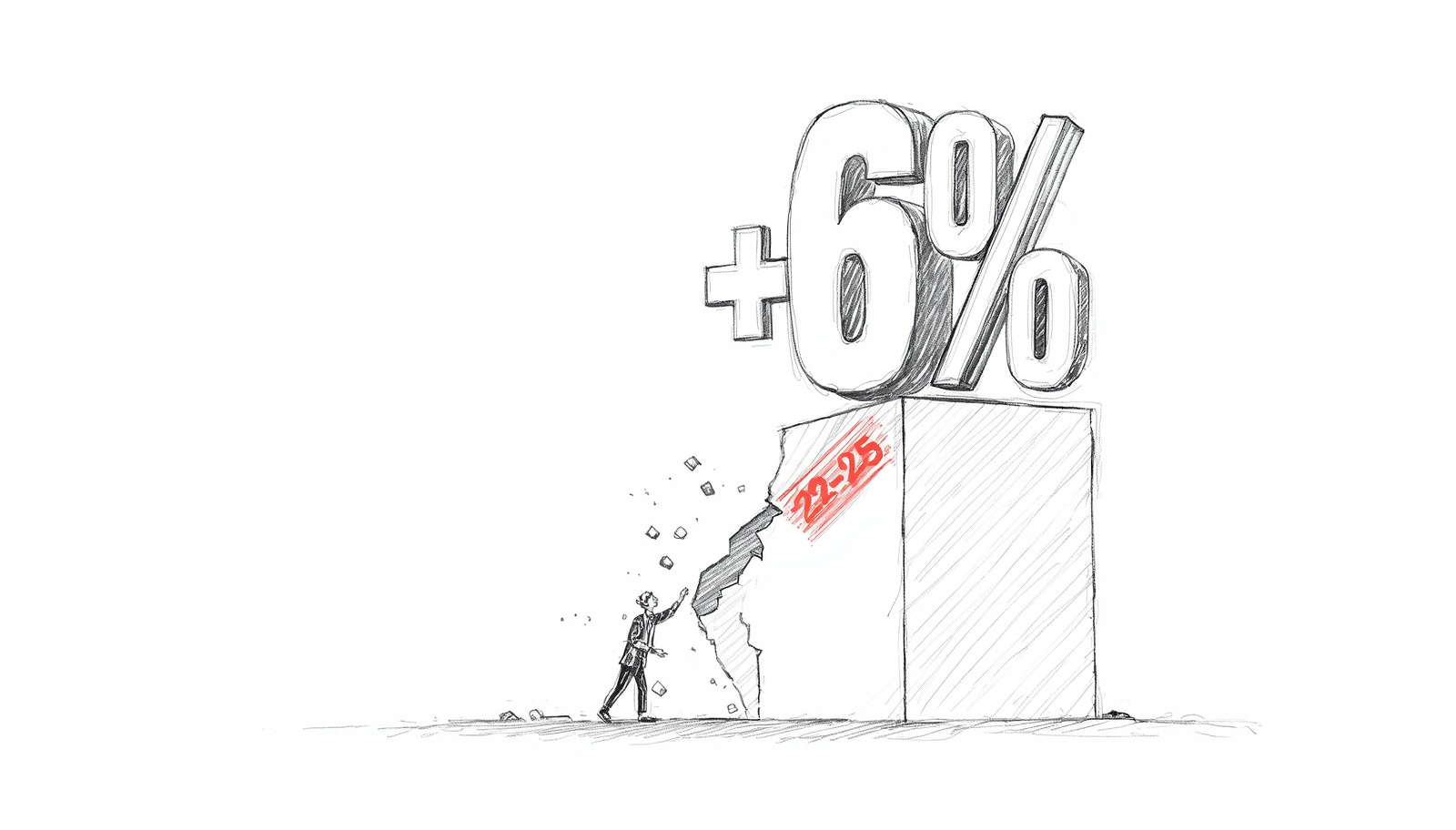
Employment in that sample grew about 6% between November 2022 and June 2026. The most AI-exposed fifth of occupations grew about 4%. Two percentage points of drift across three and a half years, which is why the “where’s the carnage” articles keep getting written and why they’re not wrong.
Split the same data by age and the floor gives way. Workers aged 22 to 25 in the two most exposed quintiles: down about 11%. Same age group, three least exposed quintiles: up about 10%.
Twenty years of running hiring teams and I’ve never seen a number split that cleanly along one line. Not 2008, when everything fell at once. Not 2020, when everything stopped at once.
The missing layoffs
In May 2025 Dario Amodei (CEO of Anthropic) said half of entry-level white collar jobs could vanish. Sam Altman followed a month later with the end of whole job categories. Then a year passed, the Guardian ran a piece asking where the carnage was, and the honest answer was that it hadn’t shown up in any aggregate number anyone could point at.
Both things are true, which is why the argument on LinkedIn goes in circles. And of course, people are out here posting quotes from these two CEOs, racking up those likes left and right.
The paper I was talking about at the beginning is the August 2026 update to “Canaries in the Coal Mine?” by Erik Brynjolfsson, Bharat Chandar and Ruyu Chen at Stanford. They use ADP payroll records, millions of workers, running through June 2026. Their headline finding: employment for 22 to 25 year olds in AI-exposed occupations now sits 19% below where it would be if it had kept pace with their less-exposed peers. Experienced workers show no equivalent gap. When they first published in August 2025, that same measure read 15%. It has widened every time they’ve refreshed the data.
I’ve read every version of this paper since the first one, mostly because people keep forwarding it to me with the subject line “thoughts?” and no other text. (I “love” this on LinkedIn)
It’s worth knowing how that 19% is built, because it gets misquoted constantly. People read it as a fifth of young workers losing their jobs. It measures the distance between two growth rates. Young workers in less-exposed occupations grew about 10% over the period. Young workers in the exposed group fell about 11%. The distance between those two paths is 21 percentage points, which works out to 19% relative to the growth the less-exposed group managed. Earlier versions of the paper led with a regression estimate instead, which produced 13% and then 16%.
The authors have moved to the simpler descriptive gap because it requires no modelling choices, and I think that was the right call, though it does mean the number people are quoting changed its definition halfway through the story.
The 22 to 25 cohort is a small slice of the workforce, under 10% of the sample, so a large move inside it barely disturbs the national figure. You get a labour market that looks fine from a distance and feels catastrophic to anyone who graduated in 2024. Total employment for that age group came out roughly flat across the whole period, down 1.9%, because growth in the less-exposed occupations absorbed most of the fall. Young people did find work. They found it somewhere else, doing something else, usually for less money than the degree implied.
Every headline about this study describes it as evidence of AI destroying jobs. The authors describe their findings as descriptive facts they explicitly refuse to call causal. Those are different documents.
Ninety seconds, no paperwork
I didn’t push back on my friend over dinner and I still half agree with his call. His group has unusually strong seniors and unusually well-documented processes, and he told me later they’d opened two junior roles on a different team that year. One story from one company proves very little.
What it does show is the shape of the thing. That’s how the 19% gets built. A thousand small conversations where the junior version of a role quietly becomes the senior version, and nobody logs a reason.
Which creates a strange problem for anyone trying to study this. If you survey employers and ask whether they’ve replaced staff with AI, most will say no, and most will be telling the truth. The req was never filled, so nobody was replaced. The headcount that didn’t get approved leaves no trace anywhere except in payroll data years later, which is exactly why this paper needed millions of records to see something that every recruiter I know has felt since roughly early 2024.
There’s also a self-serving version of this I should name. “The AI can do it now” is a wonderful sentence for a hiring manager under budget pressure. It sounds forward-looking rather than defensive.
Separation rates ruin the displacement story
The most useful finding in the paper is the one nobody quotes, because it’s the fourth of six facts and journalists stop at two.
The decline runs through hiring, not through firing. The researchers measured separation rates for young workers in the most exposed occupations and found they fell at least as much as in the least exposed ones. If AI were pushing people out of jobs they already had, you’d see the opposite. What opened after 2022 was the gap in hiring rates.
So the people this is happening to are, in the technical sense, nobody. They don’t appear in a layoff announcement. They don’t file for unemployment from a job they held. They’re at home, four hundred applications deep, being told by every career influencer that they need to fix their CV formatting.
A quick aside about the data, because it changed how I read everything else in the paper. ADP only observes job titles for about 70% of workers in its system. Roughly a third of the sample needs its occupation filled in by other means. Anyone who has ever tried to run a headcount report out of an ATS knows exactly this problem: the titles are a swamp, half of them are internal jargon, and the mapping to any standard occupation code involves judgement calls that nobody documents.
The Stanford team handles this more carefully than most, and they publish their approach. It still means every occupational number in this debate rests on a layer of cleanup work that almost no one reads.

Codified knowledge got cheap first
Fact five is where the paper stops being a headline and starts being useful.
They split occupations by how AI is actually used in them, borrowing usage data from the Anthropic Economic Index, which classifies conversations as either automating a task or assisting with it. In occupations where usage leans toward automation, young workers’ employment falls, and the gradient is steep. In occupations where usage leans toward assistance, employment for young workers isn’t ordered by exposure at all. The most exposed quintile on that measure is among the fastest growing.
The mechanism they propose for the age split is that generative AI substitutes best for codified knowledge, the formal, documented, teachable kind, and complements tacit knowledge, the sort you only get from doing the work badly for a few years first. Occupations heavy on codified knowledge show slower entry-level growth. Occupations heavy on tacit knowledge show faster growth for mid-career and senior workers.
Which is a polite way of saying that we spent forty years building an education system optimised for the exact thing that just got cheap, and the bill arrives for people aged 22.
I find this the most credible part of the paper because it matches twenty years of intake conversations. When a manager describes a junior role, the tasks they list are almost always the documented ones: pull the report, draft the first version, check it against the standard, escalate if it looks wrong. Those are the tasks you can write down, which is why they end up in a job description, which is why they’re also the tasks a model handles competently. The parts of the job that make someone valuable in year three rarely appear in the ad at all, because nobody knows how to specify them.
Now the part where I am not sure 100% about. When the researchers control for the share of workers in an occupation holding a college degree, their headline estimate for the most exposed quintile shrinks from −0.18 to −0.09. It stays significant, barely. They argue education is plausibly the channel AI works through rather than a competing explanation, and I find that argument reasonable, but “reasonable” is doing a lot of lifting. The effect is also more pronounced in the ADP panel than in national survey data. I don’t think either caveat kills the finding. I do think anyone posting the 19% figure without mentioning them is selling something.
The strongest counterargument comes from Stanford’s own economists, in a July 2026 policy brief out of SIEPR. Measured by unemployment rate, the most AI-exposed quintile of workers is up 0.77 percentage points since 2022 and the least exposed is up 0.85, which looks like a labour market softening evenly rather than one being cut apart by software. I’d point out that occupational unemployment is assigned by the job someone last held, so a graduate who never got hired into an exposed occupation never enters that quintile at all. The measure is close to blind to the exact mechanism the payroll data describes. That doesn’t make it wrong, and the same brief lands on both findings without pretending they cancel.
What I tell people who ask about entry-level roles
I’m skipping the whole debate about whether AI creates new job categories to replace the old ones. It might, but I have no useful information about that, and if I don’t have enough data, neither does anyone else writing confidently about it.
For someone graduating now into an exposed field, the advice that follows from this data is unpleasant. Stop optimising for the best first job and start optimising for any job where the tacit part is large. Look for roles where the value sits in reading a room, handling an escalation, or knowing which supplier actually delivers on time.
The paper’s split between automating and assisting usage is the closest thing to a map I’ve seen, and companies differ enormously on this even within the same industry. Two software firms of identical size can be running completely different experiments on their junior population.
The cost of that advice is real, it usually means a smaller company, a worse salary, and a title your classmates will find underwhelming for three years. I’m not going to tell you the sacrifice pays off, because I’ve watched it not pay off.
But where most people quit is here. They keep firing applications at exactly the roles their degree pointed at, because switching target feels like admitting the degree was a mistake. Six months in, the CV has a gap on it and the story gets harder to tell. I’ve interviewed a lot of those candidates. The gap is survivable. The bitterness that comes with it is much harder to hide in an interview than people think, and it shows up in small ways, in how someone answers a question about a former manager, in the length of the pause before they say something positive about a company that rejected them.
The other half of this sits with employers: if the mechanism in the Stanford data is real, then any company cutting junior hiring right now is borrowing from its own mid-level supply in 2029, at a price it doesn’t yet know. Firms that keep an on-ramp open are running a slower, more annoying, more expensive operation for the next two years and will be the only ones with internal candidates after that. I believe this. I also notice it’s exactly what someone who has spent a career in hiring would want to be true, and the incentive to believe it is enormous, so weigh it accordingly.
But where I keep seeing this fall apart is mentoring. Everyone assumes that when you hire juniors, seniors will have the time to teach them, but in most teams I’ve seen, that’s just not the case.
The exact case I would make for a junior req
Start with the number nobody uses, because it reframes the whole conversation from “is AI taking jobs” to “which team are you on.” Here is how to do that: